
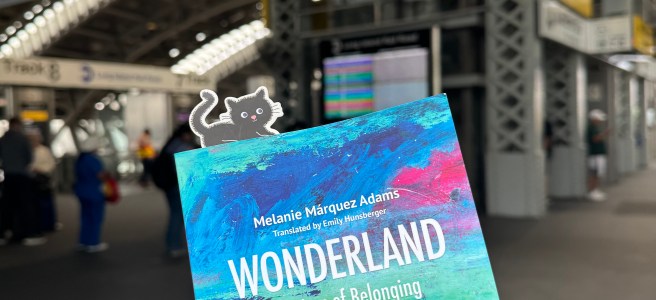
Melissa Martínez-Raga. Wonderland: Crónicas of Belonging in América’ by Melanie Márquez Adams. USA: Mouthfeel Press, 2025. 102 page
Welcome to Wonderland! No, not Alice’s, but another version, the one visited by Melanie Márquez Adams. Born out of a superb collection of living crónicas and a collaboration between the author and Philly-based translator Emily Hunsberger, this tea party we’re all invited for will soon feel like a vivid conversation with friends.
Framing this entire collection, “Wonderland” sets the stage, where an awkward conversation with an acquaintance about identity leaves the author (and certainly, us) initially dazed and defensive. Here, Márquez Adams establishes outright that hers does not represent a tragedy-ridden immigration story; she was a mobile, scholarly, and relatively privileged adult at the time. However, as soon as nuance is disregarded comes the uncomfortable shame and embarrassment of being othered, misunderstood, and even coerced, suddenly, into the language and contexts of a new land.
But Márquez Adams doesn’t just grumbly complain or naively marvel at the new; she invites a level-headed pragmatism back into this dying-to-be-sensational narrative — recognizing the truth in the acquaintances’ words, while also holding space for the burden of migrants of carrying multiple perspectives and analytical frameworks. It is rarely black-and-white ignorance; it is more often a very careful, challenging, and multifaceted juggle. This complexity of experiences, in fact, you can’t help but adopt for yourself throughout the read.
Soon you realize this reaction comes from a lived reality of refusing to just go along with hegemony. In “The Color of Lakes” and “Campus Selfie,” Márquez Adams takes on the challenge of relating one of her most culturally shocking experiences — studying and living in Tennessee. For one, there is a level of fun in delighting single-minded estadounidenses simply with your words and explanations of home, but the other face of the coin is having to face their unfiltered expectations, projections, and prejudices that come with their awareness that you are non-estadounidense. Be it because of youthful insensitivity or experimenting with passion, there is also a level of fetish for the moment that it serves them. Somehow, even more bizarre, insofar what it does to an educated migrant’s interior world, is learning your own history in a foreign land like a U.S. college classroom. It’s a peculiarly debilitating feeling of sadness and shame when you realize how little you know about your own land and how a certain amount of indoctrination begins as soon as you absorb analyses from an outsider point-of-view. Leading to how little people begin to regard your troubles, like in “One Hundred Cornfields of Solitude,” and in response, how little you must start regarding the troubles of others, like in “Interpreting the American Dream,” and even belittling your own, like in “Belonging.”
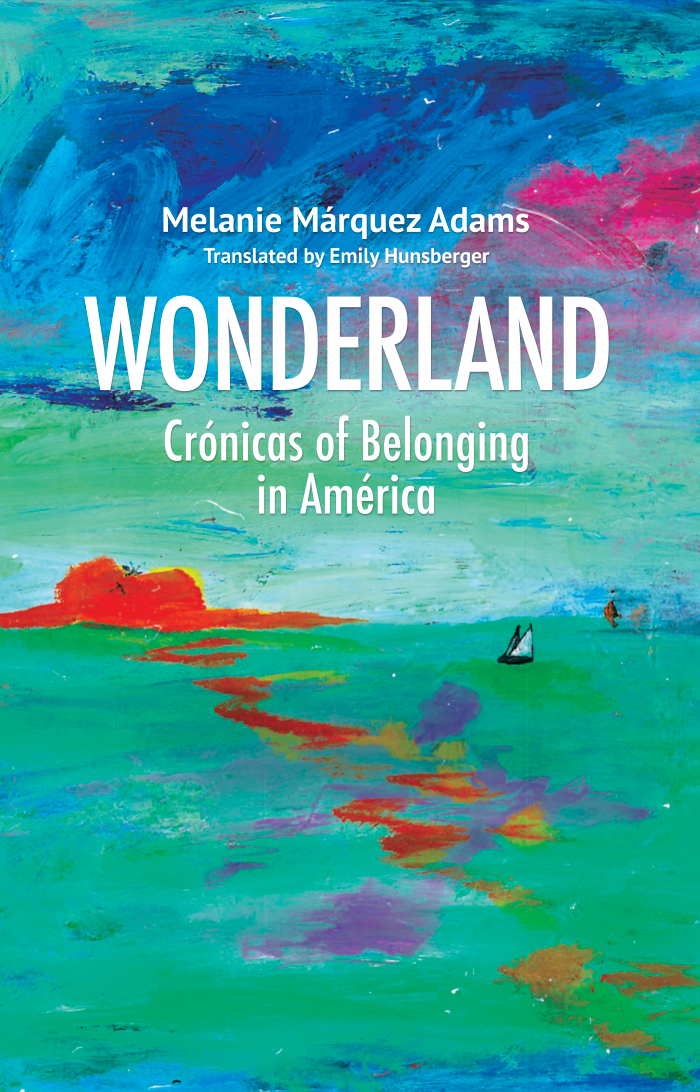 Situated in space, initially, the collection soon starts feeling like a sort of fever dream. Because there is no real unique experience, as the parallels and metaphors that Márquez Adams offers — in “Appalachian Ballad,” “Boardwalk Rhythm,” “Ghosts of the South” and more — make clear. The United States is an active immersion into so many stories and myths and places and adventures in common with other places in the world. What makes boardwalks unique, for instance, is not just how they stand out locally in Coney Island or Santa Monica, but the déjà vu that can suddenly overwhelm anyone from around the globe upon remembering their own coastal cityscapes. How it feels to hear the universal calling of the sea across different hemispheres. Indeed, this is a country of immigrants, and this country is made up of immigrant experiences, experiences that people have had in other countries and have brought with them out of love and enrichment of the United States. Even if they are changed. If all migration roads lead to the U.S., all in the U.S. leads to other countries. Speaking to the remarkably vast mobility of Latines, no one experience is ever the same as another, but the United States is certainly the meeting point.
Per the poetic side quest and midway marker in this book, language becomes a choose-your-own -adventure that both manifests and chronicles life itself. These stories do a phenomenal job at equally analyzing as well as playing with it all. Language itself is not an inherent barrier; the real barrier is people’s willingness to engage openly and humbly with cultures other than their own. Wonderland is a reminder to imagine, to anticipate yourself moving in and out of spaces, because we, Latines, know: open-minded adaptability — not necessarily controlled stability — in this ever-changing world is the new reality for living a fuller, more fulfilled life.
As personal as these chronicles remain for the author, Márquez Adams’ writing just gets that deep and intimate with the reader. It is, truly, pura magia imbued with a seductive musicality. It transports and transforms you before you even know where it’s taken you, much like life itself. Reading her is like being immediately enticed by the rhythms of a song before you finally understand the lyrics and fall in love with it all over again, hard and forever. Without a doubt, the few hours I spent with these chronicles (more like, devoured!) made me feel less alone. It lured me into a visceral confrontation with myself that I long had been putting off, and that I can no longer ignore moving forward as things evolve – socially, economically, politically. Our reality is worth telling and it is worth dissecting; it is worth living and experiencing to its full capacity, without filters, censures, or borders.
In the end, what we have is a woman boldly exercising her mobility and refusing to define herself by any single place, but by all of them together. We see an American traversing America, from south to north and west to east and back, with all the complicated feelings and reactions that come with daring to move through space and time. And most of all, here, we find the extraordinary in the ordinary. Having read just about anything the prolific Márquez Adams puts out, this is certainly the most vulnerable, most expansive, and most audacious that we’ve seen her yet. I can’t wait for what comes next.
Melissa Martínez-Raga is an editor, writer, and sensitivity reader, born, raised, and based in Puerto Rico. She holds a B.A. in English from The University of Iowa and serves as Creative Assistant to New York Times bestselling author and Pulitzer Prize finalist Xochitl Gonzalez. Follow her work: melmraga.com.

 el roommate: colectivo de lectores